Monday, June 16, 2008

Access to food and walkable communities

I moved to Louisiana just after college. I spent the four previous years living carless in Philadelphia. The transition from a carless lifestyle in a city to what I like to call the smallest big city in America was eye opening. So many things about that move changed how I view food and the way we buy, prepare, and eat it. Two things about my personal experience really stick in my mind: access to healthy food and walkable communities.

I moved to southeast Louisiana just a few weeks after Katrina and Rita hit. Everything was in chaos, and I'm still amazed that I managed to find a place to live. People laughed when I asked if they had any vacancies. A friend of a future coworker decided it was easier to rent to me than to call back all 400 people who had left messages on his answering machine about his one vacant apartment. I rented the apartment sight unseen.

The dishwasher was broken, the water tasted fishy, the bathroom walls were made of glass, and there was a hole in the doorway where one night a frog wandered in and climbed into my bed. And yet I was relieved to have anywhere to live at all. But what a change it was from Philadelphia.

Just like in Philadelphia, I lived within a mile of a supermarket, a pharmacy, a video store, and a park. But in my new neighborhood, it was impossible to walk to any of them. There were no sidewalks, the road, where cars careened at 50mph, had no shoulder, the edge of the road quickly gave way to a water drainage ditch that was tacky with mud, and an interstate highway separated me from that supermarket. And so I no longer walked to work and on errands. I no longer took an evening stroll to relax. And I gained 10 pounds.

As I neared the end of my first year, I began looking for a new place to live. A year after Katrina and Rita, the vacancy rate in my town still rivaled Manhattan's. I had two requirements for a new apartment: sidewalks and somewhere worth walking to. It took a month of combing the streets looking for "for rent" signs (no one bothered to advertise, places went so fast), but I finally rented the first floor of a building downtown. There were sidewalks. And I could use them to walk to a library, museums, restaurants, the post office, parks, the bank, and the Saturday morning farmers market.

And slowly the weight came off.

But I haven't gotten rid of my car yet. Even though there are many, many places for me to walk to in my new neighborhood, there's not a single supermarket. The closest grocery store is about three miles away down a very busy street. I considered taking my bike, but a friend who works in the ER told me how she always sees immigrants in the ER who have tried to bike down my city's main streets. And I, too, see them every week. I hold my breath as I watch them pedal down the street, groceries hanging from a broom stick tied to the handlebars of their bikes as cars pass them honking their horns.

For people in my neighborhood without cars, and many of my neighbors can't afford them, the only choice besides the farmers market (only open for four hours on Saturday morning) or restaurants is a convenience store. The kind of store where you can buy packaged, shelf-stable food and a gallon of really expensive milk. The kind that doesn't carry any fresh food whatsoever.

And it became clear to me that there's no one big problem with our food system. It's a series of problems. I constantly hear people say that fat people have no self control and that the poor could eat well if they really tried. But it's not lack of control and laziness. It's a hundred little obstacles in the way like a highway blocking the path to the grocery store.

Monday, June 9, 2008

Ballin'

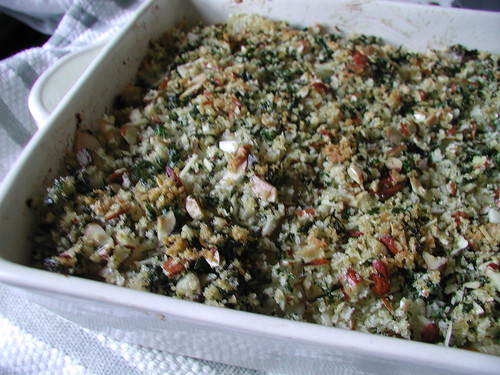
This past weekend, my kickball team got together for matzah ball soup. The woman who hosted everything was nice enough to make a vegetarian soup, too. So of course, I had to bring a kugel.


Kugel is basically Jewish casserole. If you're British, you might call it pudding. Potato kugel, sweet or savory noodle kugel, and broccoli kugel are all traditional. This is cauliflower leek kugel. And it is not at all traditional. There are herbs! And leeks! And nuts!

The first time I made this someone told me he didn't finish his first helping because it was so good, he thought it wasn't kosher. This past weekend, a woman told me it was better than her grandmother's kugel. I don't want to get anyone in trouble with their Bubbeh, but this stuff is good.

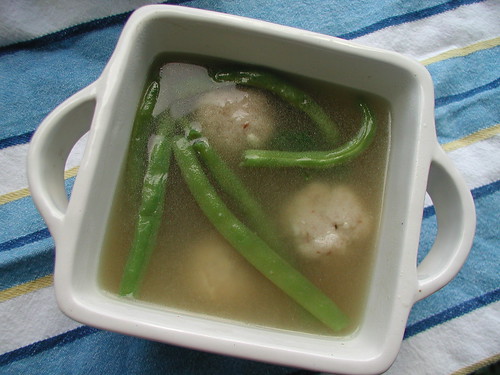
This is all to prepare you for the matzah ball soup. See, Eastern European Jewish cooking hasn't changed much. Did you see how excited I got about the fresh herbs? So when I saw that my friend had added vegetables to the soup, I was amazed and delighted. Green beans and new potatoes in the matzah ball soup. It was enlightening. Traditionally, matzah ball soup is just matzah balls and broth. Maybe a sliced carrot. (But never in my mother's soup.) So the idea of adding fresh, spring vegetables really blew me away. Enough that I went home and made my own matzah ball soup. I made this recipe, boiling the vegetables in the broth while the matzah balls cooled in the fridge. The cooked vegetables hung out in a bowl while the matzah balls cooked. If you've read much of my blog, you'll know to trust me when I say the matzah balls absolutely have to wait in the fridge an hour before you cook them. I'm all about the short cut, but you don't want to end up with matzah balls that disintegrate.

Saturday, June 7, 2008

Vegetable pasta, two ways

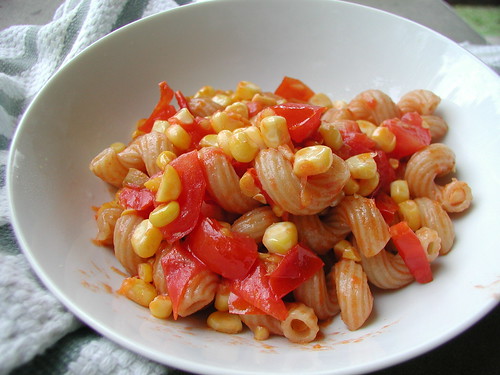
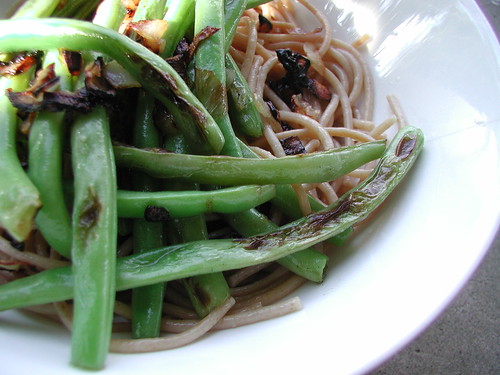
Looking over my posts, two things are pretty obvious. One, I eat 90 percent of my food out of bowls. And two, I like cooking techniques that let me throw things together without fussing too much about recipes and measuring. In honor of both of these things, I present you two vegetable pasta dishes that look and taste pretty different, but are prepared using the same method. And in a bowl.

Corn-Tomato Pasta

Green Beans and Caramelized Red Onions with Spaghetti

So here's the loose method.

Step 1. Boil pasta. You know how to boil pasta right? (Did I ever tell you about the time I tried to teach a roommate how to boil pasta?)

Step 2. In a frying pan, heat enough oil to coat the pan. I usually swig my bottle of oil around the pan twice. If you're a measure-er, this is probably about 2 tablespoons. If you're using onions or garlic, add those to the pan first. You want to give them enough time in the pan to mellow out so you don't get that sharp taste from either of them. When it's time to add your corn or green beans, turn the heat up. You want the outside of these vegetables to get crispy, even a little blackened. It adds flavor. You can test whether the vegetables are done by poking them. I suggest using a fork to poke. Fingers are too easily burned. The vegetable should give a little, but not too much. You can also try biting into a vegetable, but remember they're hot.

Step 3. Add the tomatoes to the saute pan last, if you're using any. They're going to release a lot of liquid, and this means that your other vegetables won't be frying so much as steaming. Cook the tomatoes until they start to fall apart. Depending on how small you chop them, this can take anywhere from 10 to 20 minutes. The juices from your tomatoes will mix in with the oil and create an orange-colored sauce. This is a good thing.

Step 4. Add the drained pasta to the vegetables and mix everything together well. You might want to add some olive oil for more flavor. You definitely want to add salt. Serve in a bowl.

Tuesday, June 3, 2008

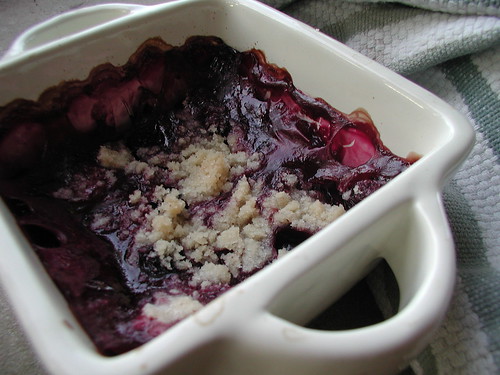
blueberry crumple

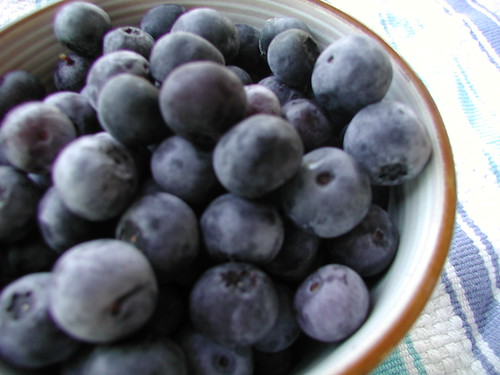
This was the last week for strawberries at the farmer's market ($1/pint!) and the first week for peaches and blueberries ($3/pint!). The blueberries were so cheap, I bought two pints. So now I have three pints of fruit. Did I mention I have a hard time eating fruit? A pint of blueberries is going into the freezer, but that still leaves two pints of fruit for berry desserts. And so we have, individual blueberry crumple. Not quite a cobbler, not quite a crumble. Still delicious.


I was out of oatmeal, so I made my usual crazy cobbler recipe without the oatmeal. Like most of my favorite recipes, it doesn't really have a recipe.


Blueberry Crumple

Mix equal parts flour, margarine (or oil), and sugar*. Add a sprinkle of cinnamon if you feel like it. The mixture should be crumbly. If it's too wet, add more flour and sugar. If it's not sticking together enough, add more fat.

Put your berries in a baking dish. If they aren't very sweet, add a bit of sugar of your choice. Sprinkle the flour mixture on top and bake at 350 degrees for about 20 minutes or until it smells too good to wait any longer.

*If you want to go the traditional crumble route, add an equal amount of quick or regular oatmeal.

Thursday, May 29, 2008

You made what?

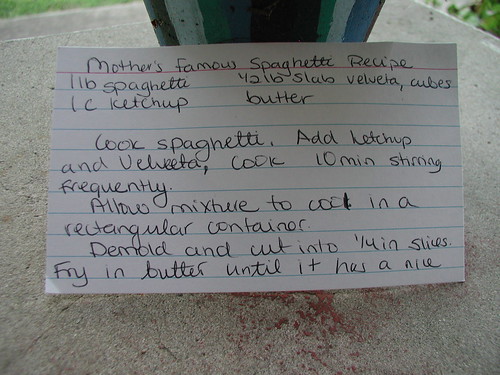
I love to thumb through cookbooks. If you invite me over to your house, I'll probably take a peek at what's on your cookbook shelf. And sometimes, the odder the recipe the better. I found the above recipe in an old community cookbook. In case you can't read the recipe card, the ingredients are a pound of spaghetti, half a slab of velveeta, a cup of ketchup, and butter (the butter is for frying of course). The recipe is called "Mother's Famous Spaghetti Recipe". I copied this recipe back in the days when I didn't give a second thought to eating food products like velveeta. But even then, this was never a recipe to make. I copied the recipe down onto an index card just so I can stare at it every once in a while. Someone once thought, "You know what would make an awesome spaghetti sauce? Ketchup and velveeta. Ooo, and when it cools down, I can fry slabs of it in butter!" Genius.

I still sometimes see a recipe and think, that's so weird. I have to make it. When I first got How to Cook Everything Vegetarian I found a few recipe ideas that fascinated me, including this recipe for seaweed mayo. That's right. Mark Bittman wants you to blend seaweed with olive oil in your food processor and then eat it as a spread on a sandwich. I couldn't resist.


And actually, it's pretty good. Surprisingly good. It looks almost like a pesto. And it doesn't taste like a catfish pond, which is what I expected. The fishy flavor is mild, and there's a bit of rice vinegar in there for tang. This is the kind of thing that you eat spread on a sandwich and think, what IS that. Taking one bite after another until it's all gone and you still don't know what you ate. I'll definitely be making this again.

Wednesday, May 21, 2008

More food in a bowl

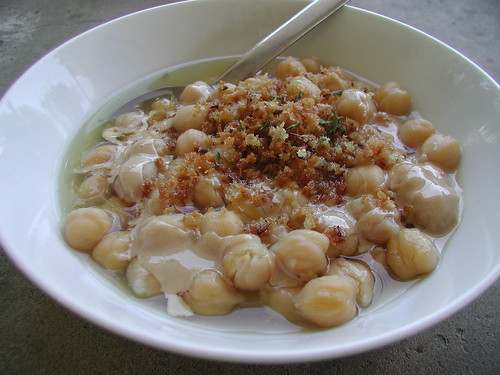
Chickpeas in their own broth

I finally got it together this weekend to cook up a pot of beans. Once a month or so, I like to cook a pound or two of beans. I use some up right away, and the rest goes into the freezer. The bean of the month for May is the chickpea. Chickpeas are one of the longer cooking beans, taking up to three hours to soften. Fortunately, I was so together this weekend I even managed to soak the beans overnight. Soaking isn't absolutely necessary to cook beans, but it dramatically reduces the cooking time. After soaking for ten hours (I had a good long sleep), my chickpeas cooked up in just over an hour.

While the beans cooked, I came up with a list of ideas for what to do with them. I'm just about out of tahini, so hummus was out of the question. Chickpea cutlets, warm chickpea salad, roasted chickpeas, saffron rice with chickpeas, and the simple dish above all made the list.

Chickpeas in their own broth is another Bittman inspired dish. He raves about the flavor of chickpea broth, and I have to agree with him. I'm never pouring this stuff down the sink again. The chickpeas are spooned into a dish with their liquid, and then drizzled with lemon juice and tahini and sprinkled with spiced toasted bread crumbs. I love dishes like these because they're practically recipe-less.


Thursday, May 1, 2008

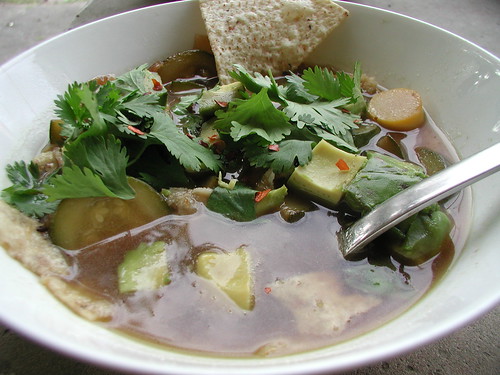
Tortilla Soup

The first of the summer's squash showed up at this weekend's farmers' market. And tortilla soup is always the first recipe I think of when confronted with a vegetable drawer full of summer squash. My friend Merf taught me to make tortilla soup this way one summer when we both worked testing ESL students. After tasting this, our coworkers wanted to know why we were bothering to go to college. After all, we already knew how to cook.

Merf is the kind of cook who throws in a cup of this and a dash of that and mixes it up up with her hands. Every time she makes a dish it comes out a little different, and it's usually pretty delicious, too. The amounts in this recipe will be vague because it just wouldn't be right otherwise.

Free Spirit Tortilla Soup
oil for sauteing
an onion, chopped
garlic, minced
summer squash, sliced and cut in half if the pieces are large
broth
salt

Saute the onion over medium heat until soft. Add the garlic and cook until fragrant (about thirty seconds). Add the squash and saute until the squash is golden and soft but not mushy. Add the broth until it covers all the vegetables by about half an inch. Heat the soup and salt to taste.

My friend E tells me that when Merf taught her to make this soup, they added tomatoes with the broth. So feel free to add tomatoes. Or anything else.

The most important part of this recipe are the garnishes. Garnish with

a squeeze of lime
cilantro
avocado, chopped
broken tortilla chips